Plate I
Indiana Glass
Standard covered hen, about 7 inches, normally unmarked. Read the flat unsplit tail, the round valve mark on the back, and the rim and nest era clues.
View Guide
Welcome to
Learn. Identify. Collect.
A welcoming resource for discovering, identifying, organizing, and enjoying Hen on Nest pieces.
Featuring the Hen on Nest collection by Dan McGinnis
The opening page
Whether you are discovering your first covered dish or organizing a growing collection, this library is designed as a warm starting place for learning, reflection, and the joy of the hunt.
Turn the page to explore collector resources, journal notes, books, and a growing reference library.
Chapter One
Free collector references
Beginner reference pages for the American makers most often found on the shelf. Open any plate to read or save it.
Plate I
Standard covered hen, about 7 inches, normally unmarked. Read the flat unsplit tail, the round valve mark on the back, and the rim and nest era clues.
View GuidePlate II
Standard milk-glass form where marks beat color. Find the intertwined WG monogram, then match the split high tail, beaded rim, and basketweave nest.
View GuidePlate III
Small 5-inch form shown, where face detail matters. Study the modeled face, the indented tail edge, and the size-specific looped or basketweave nest.
View GuidePlate IV
Revival hen form — use the period mark when available. Check LIG and ALIG initials, match the divided tail and compact oval nest, and know the mold history.
View GuidePlate V
Large slag-glass form shown, where a label or provenance helps. Separate the sizes, use provenance, and know the mini chick salt apart from the large hen.
View GuideFrom the journal
In-depth stories, field notes, and collector insights.
View All Articles
Hen on Nest
Exact measurements matter because hen on nest dishes were made in many closely related forms. Collector research documents examples ranging from less than two inches to about eight inches long, with five- and seven-inch dishes historically among the most common. Those figures describe length, not official size classes.
October 10, 2026
Read Article →
Hen on Nest
Pressed glass was never perfectly uniform—even straight off the factory floor. Common manufacturing features can include small bubbles, inclusions, slight color variation, uneven thickness, straw or shear marks, and raised mold seams.
October 1, 2026
Read Article →Featured resource · coming soon
A future home for practical collector guides and printable identification resources.
The collector's shelf
A curated library of Hen on Nest guides, activities, and journals by Dan McGinnis.

How to Identify, Buy, Display, and Enjoy Your First Collection
By Dan McGinnis
View BookShop on Amazon
A Hen on Nest Mystery, Puzzle & Coloring Adventure
By Dan McGinnis
View BookShop on Amazon
By Dan McGinnis
View BookShop on Amazon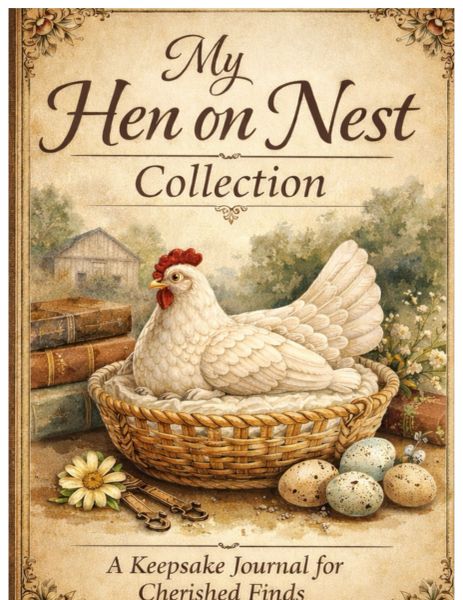
A Collector's Keepsake Journal
By Dan McGinnis
View BookShop on AmazonOpens Amazon in a new tab.
Where to buy today
Current manufacturers & resources
Makers still producing hen on nest dishes today, along with resources worth a collector's time. Separate from the identification guides above — this is where new pieces come from.

Modern manufacture, incredibly vibrant colors. Excellent display piece or useful dish for candy, treats, etc.
Collector handbook
Field notes on identifying, valuing, and caring for hen on nest dishes.
A hen on nest is a covered dish shaped like a hen sitting on a nest. Most are made in two pieces: the hen forms the lid, while the nest, basket, or bowl serves as the base. Without both pieces, you have either a homeless hen or an unusually decorative bowl.
They were used as covered serving dishes, candy dishes, egg dishes, and decorative pieces. Glass versions developed as affordable alternatives to earlier European ceramic dishes. Today, most collectors use them for display, although an occasional hen may still find herself guarding jelly beans.
Hen-shaped covered dishes appeared by the nineteenth century, and American glass examples were being produced during that period. Manufacturers continued making them throughout the twentieth century, and newer versions are still available. The shape alone does not prove age; some remarkably young hens have mastered the antique look.
Known manufacturers include Atterbury & Company, Challinor, Taylor & Company, Westmoreland Glass, Imperial Glass, L. E. Smith, Indiana Glass, Fenton Art Glass, Boyd Glass, and Mosser Glass. This is not a complete list, and many unmarked or poorly documented examples remain unidentified.
Identification requires examining the complete piece, including its size, material, color, tail shape, nest pattern, rim, base shape, lid fit, weight, mold details, and any marks or labels. One feature may suggest a manufacturer, but reliable identification comes from combining several clues. A split tail is evidence, not a confession.
Begin with the underside of the base, then inspect the inside and underside of the lid. Look for molded initials, symbols, numbers, names, or remnants of paper labels. Many authentic pieces were never marked, while others lost their labels decades ago, so an unmarked hen is not automatically worthless - or mysterious royalty.
Measure the lid and base separately in inches, from the widest outside point to the opposite outside point. Record both measurements rather than simply calling the dish small, medium, or large, since those terms are not universal size classifications. Accurate measurements also help uncover mismatched - or 'married' - lids and bases.
A split tail has a visible division or notch separating portions of the molded tail. A smooth rim lacks raised decorative beads, while a beaded rim has a row of small, rounded bumps around it. These details are useful identification clues, but none should be used alone to declare a maker.
Color can help narrow the possibilities, but it rarely proves who made a piece. Manufacturers produced hens in clear, milk glass, amber, blue, green, red, slag, carnival, opalescent, frosted, satin, and other finishes. Always compare the color with the mold, tail, rim, base, and marks before giving the hen a family name.
Examine its mold details, marks, material, lid fit, base, finish, and documented production history. Reused molds, imported pieces, mismatched parts, and undocumented modern production make identification complicated. A reproduction is not automatically bad, but it should not be described - or priced - as an antique rarity without supporting evidence.
No. Glass versions are the most familiar, including milk glass, colored glass, slag glass, and carnival glass, but manufacturers also produced ceramic and porcelain hens. Apparently, these birds were never especially loyal to one building material.
Value depends on the maker, age, color, rarity, condition, completeness, size, pattern, and current collector demand. An asking price is merely what someone hopes to receive; it is not proof of value. Before planning your retirement around one blue hen, compare it carefully with correctly identified examples.
Damage usually lowers the value, but it does not always make a piece worthless. Rarity, display appeal, and the location and severity of the damage all matter. Repairs should always be disclosed, and both the lid and base should be checked for chips, cracks, rough edges, staining, scratches, and mismatched parts.
Use gentle soap, water, a soft cloth, and patience. Avoid dishwashers, harsh scrubbing, abrasive cleaners, and long soaking when the piece has paint, flashing, labels, or delicate finishes. The dishwasher may promise convenience, but it has never respected collectible glass.
They can be displayed in china cabinets, on secure shelves, or in arrangements organized by color, size, maker, or material. For storage, wrap the lid and base separately, label the container, and avoid stacking heavy pieces together. A glass poultry pyramid is impressive only until gravity joins the hobby.
Collectors find them at antique shops, flea markets, estate sales, thrift stores, yard sales, online marketplaces, auctions, and collector groups. Every source can produce both bargains and mistakes, so inspect the complete piece before buying whenever possible.
No. Color can affect desirability, but rarity and value are not determined by color alone. Maker, condition, mold, size, documentation, and collector demand matter just as much - and sometimes more.
Free downloadable identification and reference pages will be available on the Hen on Nest Collector's Resource page. They will cover specific manufacturers, mold characteristics, terminology, measurements, and other practical subjects without attempting to cram 150 years of glass poultry into one chart.
Post clear photographs in the Hen on Nest Collector's Resource Facebook group. Include the complete dish, the separated lid and base, the underside, any marks or numbers, and accurate measurements. A blurry photograph taken from across the kitchen gives even experienced collectors very little to work with.
Visit www.DanMcGinnisCreative.com/HenOnNest for books, blogs, free reference materials, collector resources, and links to additional Hen on Nest titles.
We made a deliberate editorial decision to use AI-generated cover artwork. It gives our publications a consistent, recognizable look while reducing the risk of improperly using copyrighted photographs, trademarks, or manufacturer-specific imagery. The cover illustrations are intended to capture the charm of hen on nest dishes - not to identify a particular maker or fool anyone into believing we discovered a previously unknown million-dollar chicken. Actual photographs are used where accurate identification and comparison matter.
The collector's circle
A gathering place for fellow Hen on Nest collectors and enthusiasts to connect around the pieces and stories they love.
Join the Hen on Nest Facebook Group
Meet the author behind the publication
Author of the Hen on Nest books and the collector project taking shape here.
Learn more about Dan →About the author
Dan McGinnis is a multi-genre storyteller exploring humor, inspiration, and the creative side of everyday life.
He is the creator behind Dan McGinnis Creative LLC — a growing collection of books, journals, stories, and ideas.
Hen on Nest Collector's Resource is published by Dan McGinnis Creative LLC.
Letters from the Nest
Updates on new Hen on Nest titles, collector resources, identification and reference notes, notable articles, and occasional community news.
Your email is only used for Hen on Nest updates. Unsubscribe anytime.
From Dan's shelf to yours
Dan McGinnis's Hen on Nest books and collector titles are available on Amazon.
Shop the Collection on AmazonOpens Amazon in a new tab.